
War has disrupted the Middle East, a comparatively small, market, and the perception is that there has been little effect on global services, MDS Transmodal, however, believes we could be witnessing a broader restructuring of container services.
There are a number of ways that the conflict in the Arabian Gulf differs from other disruptive events to shipping, as Drewry analyst Simon Heaney pointed out, recently, disruption is often seen as boosting the carriers’ bottom line, as seen during Covid when lines made historically high profits.
“This current conflict is different,†said Heaney, “In the sense that it will reduce supply on a much smaller scale, but, crucially it’s not going to boost demand, and it could even lead to contraction.â€
“Outside of the Middle East the liner services have largely remained as they were,†added Heaney.
Data from analyst Antonella Teodoro from MDS Transmodal suggests that not only has there been substantial shifts in the structure of services outside of the Middle East conflict, but that this restructuring could signal a strategic change in carrier behaviour.
According to MDS Transmodal’s data the Indian Subcontinent (ICS) traffic has increased 19.6% on a monthly basis between February and April this year. By itself this could be construed as the fallout from the blockade of the Strait of Hormuz.
Middle East connections have become more complex, circuitous and expensive from the covid period. Back then freight rates and carrier profits soared to heights never seen before, because there was a combination, a toxic mix, of severe supply constraints in every link in the supply chain at a global level. And that coincided with a surge in demand for containerised goods.
Teodoro, however, points out, “This growth is not uniform as it reflects a reconfiguration of network structures, reinforcing the ISC’s role as a central transit and redistribution point.â€
Long haul services to the Far East and North America from ISC have increased 16%, and ISC capacity to Europe and the Mediterranean “surged†by 83.3%; but perhaps more significant was the 237.6% increase on ISC-Sub-Saharan Africa trades.
Overall, Teodoro believes that these service shifts, “Suggest that carriers are increasingly directing cargo through the ISC to maintain connectivity between major East-West and North-South corridors.â€
Moreover, MDS data shows the emergence of services in April that were not available in February, before the war in the Arabian Gulf began.
Service loops such as ISC-North America, utilising 81,000 teu, ISC-North America-Latin America offering 26,000 teu, and ISC-Far East-Latin America-Sub-Saharan Africa with 41,000 teu in capacity appeared in April.
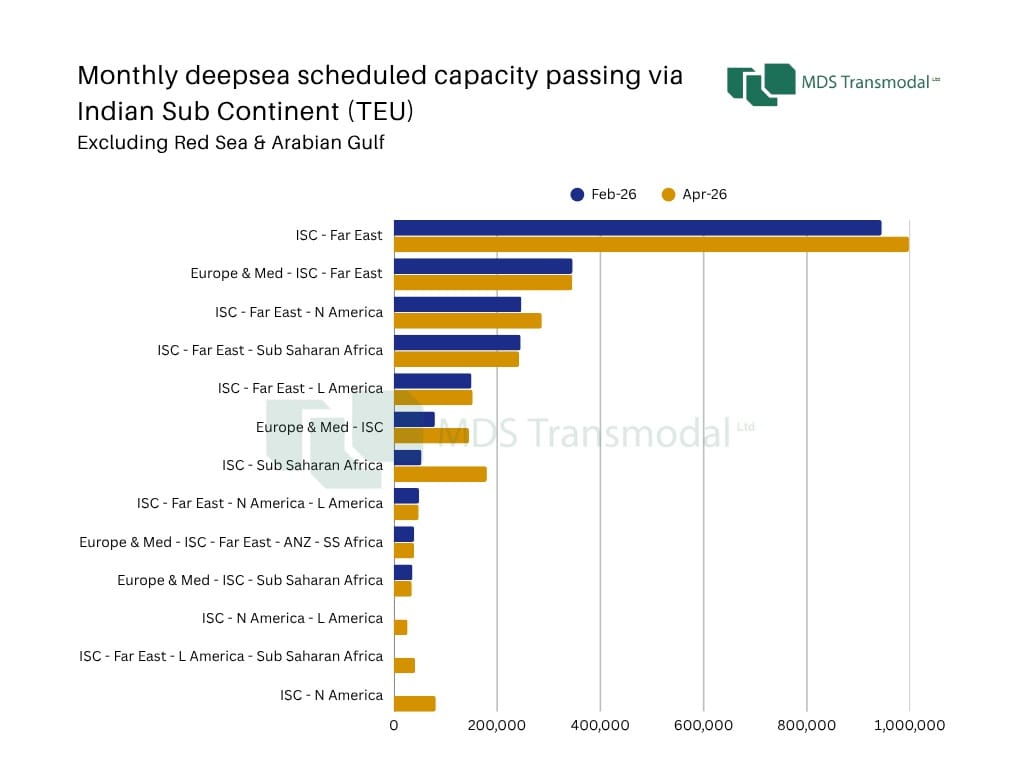
More established services out of ISC to Europe the Far East and Sub-Saharan East Africa have remained broadly the same, as Heaney suggested, but Teodoro believes that while these “legacy rotations are being maintained, incremental capacity is being deployed through more complex and diversified service strings… actively re-anchoring their networks around the Indian Sub-Continent.â€
This is not just capacity diversion, argues Teodoro, this is a fundamental shift in network design with ISC increasingly seen as a flexible transhipment hub that allows liner companies “to stitch together long-haul corridors and absorb volatility across multiple trades.â€
These changes effectively point to a strategic shift to more modular service offerings, which allows the carriers to maintain service connectivity and to mitigate disruptions in supply chains.
“In this sense, the ISC could evolve into a more pivotal junction within global liner networks, playing a critical role in maintaining service resilience and network optionality under conditions of sustained geopolitical uncertainty,†said Teodoro.
Although the consultant is cautious when asked if this is a permanent shift, she adds that this effect is more than just a volume or capacity change, but the permanence of the changes may be decided by how long the Middle East conflict lasts.
A return to the pre-war situation in the Middle East is possible, agrees Teodoro, “but it is unlikely to be immediate or complete,†she adds pointing to the precedent set by the Houthis on the Red Sea.
Network reconfigurations are operationally complex and slow to reverse and carriers tend to wait for sustained stability before reverting to previous routings, noted the consultant.
Most likely, there will emerge a dual hub, post-war, in the Middle East and ISC, which Teodoro believes is a “realistic medium-term outcomeâ€.
She added: “A dual-fulcrum system, with both the Middle East and ISC playing roles, would align well with the broader shift toward risk diversification and network flexibility. I’d say that the ISC’s growing role does not necessarily displace the Middle East entirely, but it does reduce dependence on it.â€