
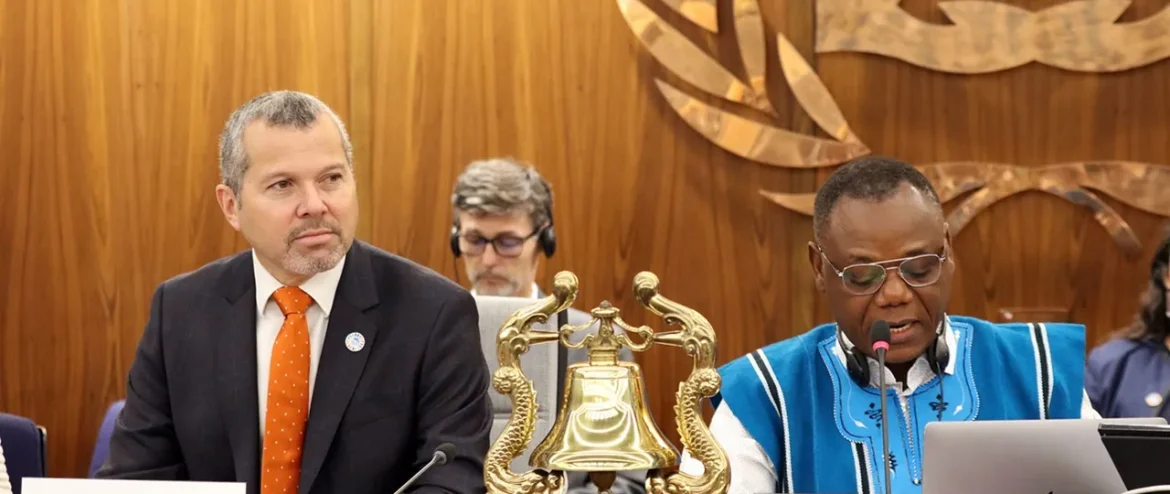
Is the irresistible force set to meet the immovable object or is the proverbial about to hit the fan. Whichever metaphor you reach for this week’s International Maritime Organization (IMO) meeting could prove pivotal for the maritime industry and its decarbonisation direction of travel.
An attempt to reach a consensus is being made by those who support the Net Zero Framework (NZF), at the 84th session of the Marine Environment Protection Committee (MEPC84) this week, in the face of a US Presidency that believes climate change is a hoax and is gathering its IMO forces to shoot down the policy.
Meanwhile, environmentalists are ramping up the pressure making their views known to delegates, they say, “Activists will transform the IMO headquarters into a site of direct confrontation—covering it with massive banners visible from the River Thames, Lambeth Bridge, and all surrounding approach routes.â€
Despite apparent impending battle lines being drawn IMO Secretary-General Arsenio Dominguez is keen to avoid confrontation saying at Singapore Maritime Week last week, “my focus is in bringing back the negotiations at IMO in the way that we used to do it, not a repeat of what happened last yearâ€.
Confrontation is also not a route that Thomas Kazakos, the Secretary General of the International Chamber of Shipping (ICS), and his partner trade associations want to go down.
He told Seatrade Maritime News that IMO is a vast organisation with many different views, and the industry will continue to look for a consensus, debating the issues, and moving forward together.
“We know that there’s been some other submissions [opposing the NZF], and we expect the members of the IMO, the governments, to start serious discussions about how they’re going to end up with one uniform consensus-built international regulation, applied throughout the world in a uniform manner,†said Kazakos.
The ultimate goal, said Kazakos is decarbonisation, but that is not necessarily the same for all member states, with the US president moving to cancel the NZF with a view to easing the restrictions on LNG and ditching the carbon fund.
Moreover, Saudi Arabia, the UAE, Argentina and Russia, and perhaps more surprisingly the EU nations of Cyprus and Greece are aligning themselves with the US position. Although for Cyprus the main issue is the NZF regulation on LNG, which could see the gas phased out by the mid-2030s.
Even as opposition lines up against the NZF ICS believes that the industry backs the NZF and that it is more united than some give it credit for.
Kazakos baulks at the view that tanker and bulk owners oppose the NZF, while container operators back the regulation, pointing to the joint statement released last week by Bimco, Cruise Lines International Association, ICS, Intercargo, Interferry, Intertanko, and the World Shipping Council, which represents liner companies and ro-ro operators.
“Industry supports the consideration of practical and effective IMO solutions with consistent global application while avoiding diverse and/or overlapping regional and national decarbonization schemes which could result in double or multiple penalties being imposed on ships for the same GHG [greenhouse gas] emissions,†read their joint statement.
It is a matter of record, however, that some Greek shipowners, powerful voices in the industry, are very vocal in their opposition to the IMO’s NZF. And the target of their ire is the LNG rules along with the slush fund proposal that will be disseminated by the IMO to allow the maritime sector to innovate and help less able countries to meet decarbonisation goals.
Speaking at last October’s Cyprus Maritime conference George Procopiou, founder of Dynacom and Dynagas, crude oil and LNG tanker companies, he spoke directly to the IMO secretary-general, who was sitting in the audience. Regulators are making shipping into “a tax collectorâ€, he said, fleecing the industry with the false hope of decarbonisation.
Procopiou was supported by all but one of his fellow panel members and cheered by some in the audience as he called for a pause in the regulations. “We don’t need Mr Trump to lead the way, we want to lead the way,†he said.
Procopiou railed against the “Jules Verne†thinking that wanted ships to operate on fuels that did not exist and called for IMO to be realistic and back the use of LNG as a viable transition fuel.
Kazakos and the ICS partners fear that backing at the IMO for the solution being pushed by Procopiou and the US would lead to a patchwork of environmental regulation that would prove impossible for any operator to navigate.
Instead, Kazakos believes the ideal solution is, “One international global measure that takes into account what’s the current availability of infrastructure and making sure that it’s enforceable in all parts of the world.â€
That according to Kazakos would avoid the measure that owners fear most: “Regional measures, national measures, and double charging… if you apply a regional scheme in Greece, then the other part of the world, Japan does the same, or Turkey does the same, or Latin America does the same, where do we end up.?â€
To avoid this situation arising the Intersessional Working Group on the Reduction of GHG (ISWG-GHG) emissions met last week with some 62 countries reportedly engaged in constructive talks on finding a consensus.
There was also positive engagement over the carbon fund and IMO’s handling of this fund, though four countries refused to discuss the issue.
Seatrade Maritime News understands that there is a willingness for countries to collaborate progress the NZF and the of the Framework, which some delegates have said, “Can be interpreted as a quiet act of resistance against Trump and petrostates who continue to strongly oppose the agreement.â€
Delaine McCullough, President of the Clean Shipping Coalition, was positive about the progress made at the ISWG-GHG, which she said countered “Opponents’ claims that the IMO is a ‘house divided’â€. She added, “IMO member states must hold the line against those looking to once again disrupt and delay. The NZF is imperfect, but is the fruit of years of negotiations and compromise, and has broad support among IMO member states.â€
Madadh MacLaine, Secretary General, at the Zero Emissions Ship Technology Association (ZESTAs), believes IMO discussions on clean energy guidelines will lay the foundations that determine the effectiveness of the NZF following more than a decade of development of the regulations.
MacLaine argues the rules will determine which fuels will be developed and warned: “Get them wrong, and we lock in a generation of vessels running on fuels that look clean on paper but deliver little for a clean energy transition.â€
ZESTAs is looking to promote a series of technologies including battery power, wind and hydrogen, which MacLaine says is proven and ready to scale up. She adds, however, green energy “Cannot compete against false solutions propped up by weak accounting methodologies. The window to set this right is open now. We need to get this right before it slams shut.”
It is clear that Maclaine sees one of the “false solutions” is LNG, a potent fossil fuel, but it is also the case that carbon charging will be necessary to make any emerging net or near zero fuel financially viable in its initial stages of development. But as the ICS has acknowledged there is significant push back against the IMO handling such a fund.
According to Kazakos it was the ICS that raised the issue of a levy system initially because there was a lack of clarity from governments as to how decarbonisation was to be achieved.
“As far as the industry is concerned, we have made it clear, and especially us as an association, that we want a workable solution [on the NZF]. As it now stands, we have a couple of proposals, one of them includes that [a carbon fund], some of the proposals don’t include a fund,†explained Kazakos.
“Whether or not it’s an issue that will be clarified within the next week remains to be seen. But what we want to see is a real commitment to engage in a discussion that has a time frame where we can have clarity,†concluded the ICS head.