
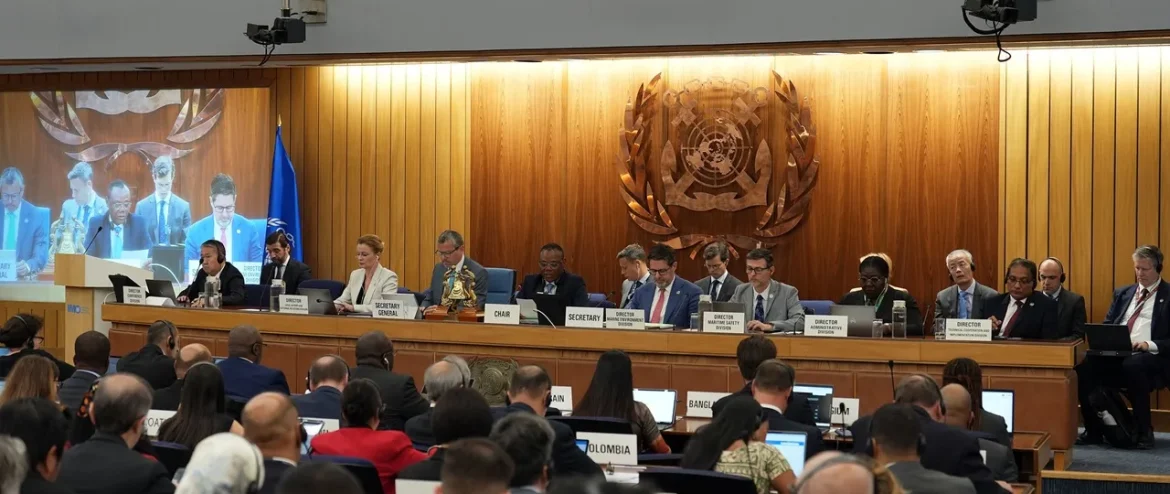
Attitudes at the International Maritime Organization (IMO) are said to be changing as the expected US tactic of leveraging support to oppose the Net Zero Framework (NZF) appears to be falling on deaf ears as delegations refuse to back the US and simply fail to meet American representatives.
Yesterday IMO Secretary-General Arsenio Dominguez berated delegates for their behaviour in October’s extraordinary session, when the US attempts to cancel the IMO’s flagship decarbonisation policy was stalled.
October’s year-long postponement of the debate has allowed some of the countries that were ‘persuaded’ by US delegates to shift away from the consensus position, backing the IMO’s proposed framework.
States re-evaluating positions
That delay has allowed some member states to re-evaluate their position, according to sources at the IMO’s Marine Environment Protection Committee (MEPC84), which will this week revisit elements of its decarbonisation policy, more specifically the carbon fund and the specific rules around LNG emissions.
One industry source, who is attending MEPC84, said that delegates are turning against the American position. They [the US delegation] are setting up meetings with country representatives, and those representatives are just not turning up.â€
They added: “The US will definitely not win the day; they’re becoming more and more politically isolated on all fronts. It’s good to see that the world doesn’t really like illegal Wars.â€
The US, supported by Saudi Arabia, the UAE, Argentina and others, proposed that the NZF should be cancelled and that IMO should allow operators to use the fuel of their choice.
In October as the US pressured smaller states to oppose the NZF and Saudi proposed a vote to postpone the decision on applying the NZF, which was already adopted by IMO at MEPC83 in April last year.
The tide is turning
At this year’s MEPC the expectation was that the US would finish the job, applying the coup de grace to the NZF, but the tide appears to be turning.
That shift is not just at MEPC, but also commercially, as Martin Crawford-Brunt, CEO at consultancy Lookout Maritime, noted: “The price of oil has increased to around $100 per barrel. This factor together with growing concerns about energy security and supply, is triggering the signing of new alternative energy supply contracts. The added volumes produced will make these fuels more available and affordable for shipping thereby increasing their viability as marine fuels.â€
Or put another way, by a second IMO source: “Donald Trump may not win the Nobel Peace Prize, but he could win the decarbonisation award.â€
This is not just a flippant comment, the source was pointing out that African, Caribbean and Pacific island nations were showing signs of Trump fatigue syndrome, realising that aligning themselves with the US was not sustainable. And many of those countries are already backed by China, which is looking an altogether more stable partner than the US at this time.
Moreover, the costs of what many countries see as an illegal war in Iran is being disproportionately felt by those same countries that the US is attempting to entice to support its view on the NZF.
A move that would lock in fossil fuels for the immediate future, whereas renewables would give emerging economies more control of their energy needs, as author and climate campaigner Bill McKibben, reportedly said: “Sunlight travels 93 million miles to reach the Earth – none of it through the Strait of Hormuz.â€